
What FMCSA’s Latest Rule Changes Mean for the Trucking Industry
June 29, 2026
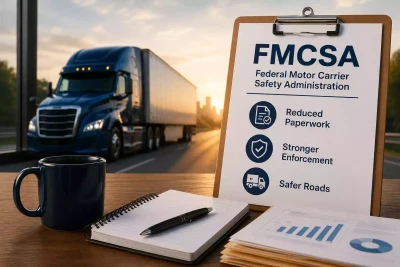 The Federal Motor Carrier Safety Administration (FMCSA) has made its priorities clear: reduce unnecessary paperwork while strengthening enforcement where it matters most.
Three new rules, effective July 22, eliminate outdated administrative requirements that no longer improve safety. At the same time, the agency is aggressively targeting fraudulent motor carriers, sham CDL schools, and “chameleon carriers” that evade enforcement by operating under new identities.
For carriers and shippers alike, the message is simple: compliance is becoming more efficient for legitimate businesses, while enforcement is becoming more aggressive against bad actors.
None of FMCSA’s latest rule changes affect core safety regulations. Hours-of-service requirements remain unchanged. Drug and alcohol testing standards stay in place. Commercial driver’s license qualifications are not being lowered.
Instead, the agency focused on removing redundant administrative requirements. Previously, CDL holders were required to self-report certain out-of-state convictions to their home licensing agency.
That requirement made sense years ago when states had limited ways to exchange information. Today, however, licensing agencies already share conviction data electronically through nationwide systems that became fully operational in 2024. Drivers were essentially reporting information that licensing authorities had already received. Removing this requirement eliminates duplicate paperwork without affecting enforcement.
Since electronic logging devices (ELDs) became mandatory in 2019, drivers have been required to keep a copy of the ELD operator’s manual inside the truck. In practice, this requirement had become largely obsolete. Most manuals are stored electronically on the device itself, while FMCSA also maintains a registry of approved ELDs. Eliminating the requirement to carry a printed manual simply reflects how drivers already access the information.
Under the updated rules, carriers will only need to sign and mail completed roadside inspection reports when the issuing state specifically requires it. Many states had already stopped requesting these reports, making the mailing requirement unnecessary for much of the industry.
These changes are part of a broader regulatory reform initiative aimed at reducing unnecessary compliance burdens.
Earlier rule updates have included:
- Clarifying that Driver Vehicle Inspection Reports (DVIRs) may be completed electronically.
- Removing outdated requirements for carrying liquid-burning flares.
- Eliminating obsolete references to water carriers.
- Updating equipment requirements that no longer reflect modern trucking operations.
These aren’t changes modernize regulations that have fallen behind current technology and industry practices.
While paperwork requirements are shrinking, enforcement efforts are expanding significantly. FMCSA Administrator Derek Barrs has made combating fraud one of the agency’s top priorities. Investigators have uncovered widespread registration abuse, including hundreds of carriers operating from the same physical address, and networks of affiliated companies created to hide poor safety records.
This practice, commonly known as “chameleon carriers,” allows unsafe companies to shut down after violations and reopen under new names with clean USDOT numbers. Research has shown these reincarnated carriers experience significantly higher rates of serious crashes than legitimate new entrants.
Rather than increasing compliance requirements for every carrier, FMCSA is focusing enforcement on companies attempting to manipulate the system.
Recent initiatives include blocking hundreds of fraudulent carrier registrations removing non-compliant electronic logging devices from certification and shutting down hundreds of fraudulent CDL schools following in-person audits.
The agency is also placing greater emphasis on verifying legitimate principal places of business and preventing companies from buying, selling, or recycling USDOT numbers.
For compliant trucking companies, these changes are largely positive. Every unnecessary form, duplicate report, or outdated documentation requirement consumes time that could be better spent serving customers and maintaining safe operations.
By removing administrative requirements that no longer provide meaningful safety benefits, FMCSA allows carriers to focus on the regulations that truly matter. Meanwhile, stronger enforcement against fraudulent operators helps create a more level playing field for legitimate carriers that invest in compliance and safety.
FMCSA’s recent actions demonstrate that deregulation and stronger enforcement are not mutually exclusive.
For reputable carriers, less administrative friction means greater efficiency. For fraudulent operators attempting to exploit regulatory loopholes, enforcement is becoming more sophisticated and far less forgiving.
At Triple T Transport, we understand how regulatory changes impact your supply chain. Our 3PL services are designed to help shippers navigate an evolving transportation landscape with confidence, connecting you with vetted, compliant carriers while ensuring efficiency, transparency, and reliability. As enforcement tightens and standards rise, partnering with a trusted logistics provider like Triple T Transport helps keep your freight moving safely and smoothly.