
Breakthrough or Breakdown? Inside the Freight Market’s Tipping Point
February 17, 2026
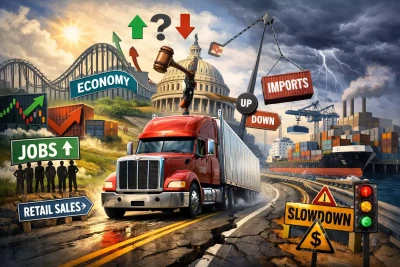 Mixed economic signals, shifting policy decisions, uneven job growth, and fluctuating import activity have created an environment where traditional freight market indicators don’t always align. For carriers, shippers, and logistics partners, the key question isn’t just what’s happening now, but what happens next.
“We talk about capacity, we talk about rates, we talk about equipment, we talk about all these different elements of the freight market. And the base element is freight,” explains FTR Transportation Intelligence Chairman Eric Starks. “Freight drives everything. So, when we’re trying to understand what the market is doing, we have to start with freight volumes.”
While consumer spending tends to dominate headlines, the industrial sector is the more meaningful driver of freight demand. Manufacturing output, industrial production, and wholesale activity generate the bulk of truckload movement. Over the past two years, industrial production has been weak. Entering 2025, there was modest improvement, but not enough to materially shift freight dynamics.
Current expectations point toward roughly 1% annual growth in the industrial sector. That’s stabilization, but not acceleration. From a freight perspective, noticeable market tightening typically requires closer to 2% or greater growth. At 1%, the system treads water. Capacity doesn’t meaningfully tighten, and rates struggle to rebound.
Will the fright market rebound in 2026? See what the data says in the latest episode of the Stay In Your Lane Podcast.
“We initially thought that we were going to be in negative territory right now in the industrial sector, but instead we’re kind of just treading water,” says Stark. “We’re going to see about 1% growth in the industrial sector for the foreseeable future.”
Headline GDP numbers have shown periods of strength. However, GDP is a composite metric. A strong services sector can offset weakness in goods production. Freight is heavily tied to goods, not services. When you isolate the freight-intensive components of GDP, growth has been limited and inconsistent. A surge in one quarter followed by contraction in the next, then stabilization at low levels, paints a picture of a market that has stalled rather than expanded. That disconnect explains why broader economic optimism hasn’t translated into a meaningful freight recovery.
Job growth has also softened in recent months, including periods of negative readings. Historically, sustained negative job growth would signal recession risk. Yet the broader economy has not formally entered recession territory. This divergence adds to market confusion. What it suggests instead is a prolonged stabilization phase: slower hiring, cautious business investment, and limited expansion rather than sharp contraction. For freight, stabilization without acceleration keeps capacity relatively balanced.
Perhaps the most disruptive factor has been policy volatility around trade and tariffs. When businesses cannot confidently forecast input costs, sourcing strategy, or regulatory impacts, they pause investment and inventory decisions. Even when initial tariff announcements drove temporary import surges, that activity did not translate into sustained inventory builds. Instead, many companies adopted a wait-and-see posture. That hesitation suppresses freight demand because expansion plans, production increases, and restocking cycles are delayed.
Another telling indicator is inventory-to-sales ratios. Across much of the economy, inventory levels remain lean relative to sales. Retail inventories are particularly low, wholesale inventories have normalized after prior excess, and manufacturing inventories remain more stable but not excessive. Despite import spikes earlier in the year, inventory accumulation has not surged.
Lean inventories can be a double-edged sword. In the short term, they limit freight demand because companies aren’t aggressively replenishing stock. But over time, if sales stabilize or improve, restocking cycles can create meaningful freight momentum. That dynamic is one of the more constructive signals as we look toward late 2026.
“Inventory-to-sales ratio levels have been very, very low and they have not come up noticeably,” says Stark. “There is a disconnect in the amount of inventory in the system, and that gives me hope that we can continue to see a rebound in the overall macro economy.”
Current freight environment can best be described as stalled but stabilizing. Industrial growth is positive but subdued, employment growth has cooled, inventory levels are lean, and policy uncertainty continues to influence business confidence.
These conditions do not produce rapid rate expansion, but they also do not signal collapse. Stabilization, while frustrating, can be the foundation for eventual acceleration, particularly if industrial output strengthens and inventory restocking resumes.
Freight cycles are inevitable. Having the right 3PL partner ensures you’re positioned to react to them.
Triple T Transport integrates carrier relationships, data visibility, and network engineering to help our partners balance cost, service, and risk simultaneously. Whether the market remains stable or begins to tighten, we provide industry-leading 3PL services that help to insulate your supply chain from volatility.